Narrative Ownership
Taking Responsibility for the Story of Your Life
By Brent A. Diggs
Writer, storyteller, and host of the Full Mental Bracket Podcast
Becoming the Protagonist of Your Life
When someone asks you to tell them a little about yourself, where do you begin?
Maybe you tell them where you grew up, how you got into the work you do, or how you met the person you married. You might talk about an experience that changed the direction of your life or someone who helped you become the person you are today.
Out of the thousands of things that have happened to you, you select the ones that seem important. You connect them, explain why they mattered, and use them to help someone understand who you are.
You tell a story.
But you don’t have to be talking to someone else to do this. It’s also how you make sense of your own life.
Think about some of the things you’ve come to believe about yourself.
Maybe you consider yourself a good problem solver because you’ve spent years figuring out difficult situations. Maybe you believe you’re terrible at relationships because several of yours ended badly. Or maybe you’ve always thought of yourself as someone who isn’t particularly creative because that’s what you were told growing up.
These beliefs developed out of your experiences and the conclusions you drew from them. Over time, they became part of your understanding of who you are.
And that understanding affects a lot more than how you remember your past.
If you’ve come to believe that you’re not good at learning new things, how likely are you to pursue something that requires you to develop new skills? How many opportunities might you pass up because they don’t fit your understanding of who you are?
The story you’ve developed about your life strongly affects how you live it.
The question is not if you are living a story. You are. It’s if you are taking ownership of that story.
What is Narrative Ownership
One of the things I find exciting about human potential is how much more we’re capable of becoming than we tend to realize.
At any point in life, we can develop new abilities, change the way we think, build better relationships, and accomplish things we once thought were impossible.
But to do any of that, we first need to reconsider some of the things we’ve come to believe about ourselves.
That’s where Narrative Ownership begins.
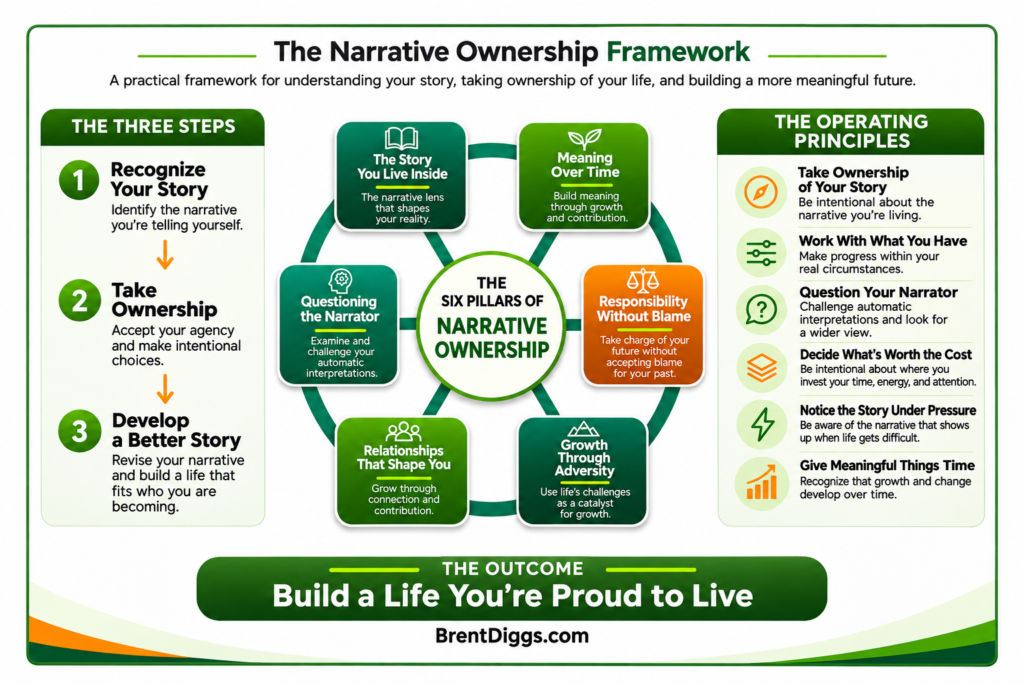
Narrative Ownership is the practice of recognizing the story you tell yourself about your life, taking responsibility for that story, and deliberately developing a better one to help you build the life you want to live.
There are three important parts to this process.
Recognize the story you’re telling yourself.
What have you come to believe about yourself and what you are capable of?
Much of that story developed without you being particularly aware of it. You accumulated experiences, drew conclusions from them, and built those conclusions into your understanding of yourself.
Once you start to recognize that story, you can see how it’s been shaping how you live.
Take ownership of that story.
You never signed up for many of the hard things that shaped your story. And some of the things you believe about yourself are simply the judgments of others that you’ve never questioned.
You may even be living with conclusions you reached about yourself when you were fifteen.
But at some point, it becomes your responsibility to examine the conclusions you’ve reached and decide whether they still belong in your understanding of yourself.
It’s your story now. And you have the power to make some edits.
Develop a better story.
Once you take ownership of your story, you can begin to examine it.
What parts of it are accurate? What have you overlooked? What have you learned since those conclusions were formed? What are you capable of facing now that you couldn’t before?
And perhaps most importantly, what might you become capable of, if you just gave yourself the opportunity?
The aim is to develop a more accurate, complete, and useful understanding of yourself and your life.
Then put that understanding to work.
Because a better understanding of who you are and what you’re capable of can open the door to a very different kind of life.
- Becoming the Protagonist of Your Life
- What is Narrative Ownership
- The Story You Tell and the Story You Live
- Taking Charge of Your Life
- Becoming the Protagonist
- The Six Pillars of Narrative Ownership
- How the Six Pillars Work Together
- The Operating Principles of Narrative Ownership
- What Narrative Ownership Is Not
- Where to Begin
- Building a Life Worth Looking Back On
- Explore Narrative Ownership
- Continue the Conversation
The Story You Tell and the Story You Live
Let’s say you’ve spent most of your adult life believing that you’re not the kind of person who is able to lead others.
Maybe you had a few bad experiences early in your career. Maybe you’ve spent years working alongside people who seemed to have a natural ability to lead, and you never saw that ability in yourself.
Whatever the reason, you’ve come to accept that assumption as part of who you are.
Now imagine yourself questioning that conclusion.
Instead of saying, I’m not the kind of person who can lead others, you begin to consider the possibility that maybe you’ve just never learned how to lead.
That’s a very different story.
One explanation describes a permanent limitation. The other describes something you haven’t learned yet.
And there’s quite a bit you can do about something you haven’t learned yet.
You can study leadership. You can find someone who does it well and learn from them. You can volunteer to take on a new responsibility and discover what you’re good at and what you need to work on.
You probably won’t be particularly good at it at first. Few of us are very good at anything the first time we try it.
But as you accumulate experience, you develop abilities you didn’t have before. You begin to discover things about yourself that your old story never accounted for.
Eventually, you have an entirely different story to tell about who you are because you’ve become someone different.
This is an important distinction.
Changing the story you tell yourself can help you recognize new possibilities. Pursuing those possibilities is how you begin to change the story you’re actually living.
And as you live that new story, you accumulate new experiences that help you develop a better understanding of yourself.
The two stories continue to shape each other.
That’s one of the ways we grow.
Taking Charge of Your Life
Think about sailing a boat.
A sailor doesn’t control the wind. They don’t control the waves, the currents, or the weather. But they can choose a destination, set a course, and learn to work with the conditions they encounter along the way.
As they develop their abilities, they can travel farther, handle more difficult conditions, and reach destinations that were once beyond their capabilities.
I think that’s a pretty good picture of what it means to take ownership of your life.
You didn’t get to choose the conditions under which your story began. And some of the biggest turning points in your life probably weren’t part of your plan.
But there’s a great deal you can do with the life you have.
You can decide what matters to you and what you want to build. You can develop the abilities to pursue those things. You can find people who want to build something with you. And when the conditions change, you can learn to adjust your course.
Sometimes you’ll discover that the destination you originally chose isn’t somewhere you want to go anymore. That’s part of the process too.
Taking ownership of your life gives you the opportunity to make those decisions deliberately rather than spending years headed in a direction you never really chose.
Becoming the Protagonist
My interest in Narrative Ownership grew out of exploring the connections between psychology and storytelling on the Full Mental Bracket Podcast.
In some of our earliest episodes, we explored the Hero’s Journey and what it might teach us about personal growth. We looked at what it means to become the protagonist of your life, find something worth pursuing, build a tribe, and develop your potential through the challenges you encounter along the way.
The more I explored these ideas, the more connections I began to see between the way characters develop in stories and the way we develop in real life.
Those connections became the starting point for Narrative Ownership.
One of the things that fascinates me about a good story is how much the main character changes over the course of it.
The person we meet at the beginning of the story usually isn’t capable of doing what needs to be done at the end. They have things to learn, abilities to develop, and relationships to build. They encounter problems that challenge their understanding of themselves and discover capabilities they didn’t know they had.
By the end of the story, they’ve become someone different.
We see this pattern so often in stories because it’s something we recognize from our own lives.
Think about becoming a parent, building a career, starting a business, or learning how to build a life with another person.
We rarely begin these chapters with all the abilities we’ll eventually need. We develop many of those abilities along the way.
The challenges we encounter, the people we meet, and the things we discover about ourselves become part of our transformation.
And that transformation opens up new possibilities for the next chapter of our lives.
Becoming the protagonist of your life means taking charge of that process.
It means finding something worth pursuing, developing the abilities to pursue it, and becoming the kind of person capable of building something meaningful.
That’s the larger purpose of Narrative Ownership.
The Six Pillars of Narrative Ownership
As I’ve explored these ideas, six areas have emerged that help explain how we grow and how we can take a more deliberate approach to building our lives.
Each of them addresses a different part of the process. Together, they help us understand the story we’re living, take ownership of it, and develop the capabilities to live a better one.
1. The Story You Live Inside
What have I come to believe about myself and my life?
Your mind is constantly making sense of the things that happen to you. It connects experiences, looks for explanations, and draws conclusions about what those experiences mean.
In the process, it builds a story that helps you understand yourself and the world around you.
Psychologists use the term narrative identity to describe the evolving story we construct about ourselves. We draw from our memories of the past, connect them to our understanding of who we are today, and use that understanding to imagine what our future might look like.
What’s particularly interesting about this story is how much of it we’ve constructed without realizing we’re doing it.
We tend to experience our understanding of life as reality itself rather than recognize it as an interpretation our minds have developed.
Every experience offers us an opportunity to learn something. Unfortunately, we don’t always learn the right lesson.
A failed relationship might help us discover something we need to learn about relationships. It might also convince us that we’re incapable of building a good one.
A difficult experience at work might reveal an ability we need to develop. Or we might interpret it as evidence that we’re simply not cut out for anything more demanding.
Over time, these explanations accumulate into a story about who we are and what we can expect from life.
And because it’s the story through which we experience our lives, we tend to accept it as reality rather than recognize it as our interpretation of events.
The problem is that we often continue living inside these stories long after we’ve outgrown them.
Identity is a snapshot of who you’ve become so far.
It reflects the experiences, decisions, relationships, and patterns that have brought you to this point in your life, as well as the conclusions you’ve drawn from them.
There’s no reason to treat it as a permanent description of who you’re capable of becoming.
The Story You Live Inside explores how our understanding of ourselves develops, how it shapes our lives, and how we can begin to change it when it no longer fits.
2. Meaning Over Time
What am I building with my life?
Everything worth building is going to require something of you.
Developing an ability takes time and effort. Building a good marriage involves learning how to live with another person whose ideas about life may be considerably different from your own. Raising a family will probably require you to reconsider some of your ideas about how much sleep a human being needs.
What makes these things worth the effort?
Meaning is the connection between what you invest in life and the value that investment creates.
Think about the years you spend developing an ability. As you get better at something, you become capable of doing more with it. You can solve bigger problems, contribute more to the people around you, and accomplish things that were once beyond you.
The value of that investment extends well beyond your own personal satisfaction.
And somewhere along the way, you may discover that the person you’ve become is more valuable than the thing you originally set out to accomplish.
That’s one of the interesting things about pursuing something meaningful. The effort you put into building something also builds something in you.
When you understand what you’re building and why it’s worth building, your efforts gain direction and your struggle gains context.
Meaning Over Time explores how we can invest in our own growth, put our abilities to work for something beyond ourselves, and build a life that becomes more meaningful as we live it.
3. Responsibility Without Blame
What can I do with the hand I’ve been dealt?
Life has a way of handing us problems we had nothing to do with creating.
Other people make decisions that affect us. Circumstances change. Things we’ve worked hard to build sometimes fall apart.
One of the things that can make these situations so difficult is our tendency to confuse responsibility with fault.
We may spend years blaming ourselves for something that wasn’t our fault. Or we may spend years waiting for the person responsible for a problem to do something about it.
Neither helps us build the future we want.
Learning to distinguish responsibility from blame can be incredibly freeing.
You can recognize that someone else caused a problem while taking responsibility for what you’re going to do about it. You can acknowledge that you’ve been treated unfairly without allowing that experience to determine the rest of your life.
You may need help. You may need to hold someone accountable. You may need to get yourself out of a bad situation.
The point is that you can begin taking charge of your future without first having to resolve everything that happened in your past.
4. Growth Through Adversity
What is this chapter asking me to become capable of?
One of the patterns we see in good stories is that the protagonist encounters challenges before they’re fully equipped to handle them.
Life works that way too.
We become parents before we know much about parenting. We accept new responsibilities before we’ve mastered the skills they’ll require. We enter unfamiliar chapters of life and have to figure out how to live in them.
The gap between what a situation demands and what we’re currently capable of creates pressure.
As we work to close that gap, we have the opportunity to develop new abilities.
This is one of the reasons I find the try-fail cycle so useful as a way of understanding growth. We attempt something, discover what we still need to learn, make adjustments, and try again.
Over time, things that once required a tremendous amount of effort become things we’re capable of doing routinely.
Of course, some of the difficulties we encounter in life serve no obvious purpose. Some are unfair, some are damaging, and some require more help than we know how to ask for.
We don’t have to be grateful for the hardships we’ve experienced to be grateful for the things we’ve learned from them.
Growth Through Adversity explores how we can put our struggles to work, develop new capabilities, and become better equipped to pursue the things that matter to us.
5. Relationships That Shape You
Who am I building my life with?
One of the things I’ve discovered about my own life is how much more became possible when I found my people.
Other people can recognize abilities we haven’t learned to see in ourselves. They can introduce us to possibilities we hadn’t considered, challenge our assumptions, and encourage us when we’re having trouble seeing our own progress.
They can also tell us things we’d rather not hear, which turns out to be one of the more valuable things a friend can do for us.
The people around us help shape our understanding of who we are and what’s possible for us.
And we do the same thing for them.
This is part of what I think of as relational wealth.
Many of the most valuable things we build in life are built with other people. Friendships, marriages, families, communities, and the work we do together can enrich our lives in ways that individual accomplishments rarely can.
Finding your tribe is one of the most important parts of developing your potential.
Learning to become a valuable member of someone else’s tribe is another.
Relationships That Shape You explores how we build those relationships, how they contribute to our growth, and how we can contribute to the growth of others.
6. Questioning the Narrator
Challenging Your Automatic Interpretations
One of the more interesting things about the human mind is its ability to construct a story out of remarkably little information.
A friend walks past you without saying hello, and before you’ve even reached your car, you’re reviewing your last conversation to figure out what you might have said to upset them.
Maybe they’re upset with you. Maybe they were distracted. Maybe they didn’t even see you.
But your mind has already developed a story about what happened, and you’re beginning to respond to that story as though it were true.
Your mind does this sort of thing all day long.
It draws on past experiences, fills in missing information, and offers explanations for what’s happening around you. Much of the time, these mental shortcuts are quite useful.
The trouble is that we don’t always recognize them as shortcuts.
Our cognitive biases can lead us to notice some things, overlook others, and draw conclusions before we have enough information to know whether they’re accurate.
And once we’ve developed a convincing explanation, it can be surprisingly difficult to recognize that it’s just an automatic interpretation: a guess that feels like a fact.
One of the most valuable abilities we can develop is learning to question the stories our minds tell us.
What do I actually know about this situation? What am I assuming? Is there another explanation I haven’t considered?
I call this practice of examining our interpretations and looking for a more accurate, complete, and useful way of understanding our experiences Finding the Frame.
Sometimes we discover that what we were absolutely certain of a few minutes ago was little more than a guess.
And sometimes we have to admit that we simply don’t know.
That can be uncomfortable, but I’d rather live with an unanswered question than build my life around an answer I made up.
Finding the Frame can help us examine more than our interpretation of a single event. We can also use it to question the beliefs we’ve accumulated over years of interpreting our experiences.
Some of the things we’ve come to believe about ourselves may be based on experiences we misunderstood, information we didn’t have, or conclusions we reached long before we knew as much as we do today.
Our beliefs are tools for navigating reality.
When we discover that one of those beliefs is inaccurate, there’s little value in hanging on to it. We need a better tool.
As we accumulate new experiences and learn new things, we can update our understanding of ourselves and the world around us.
And we don’t have to wait until we have all the answers before we do something. We can make the best decision available to us, taking into account what we know and what we don’t, and learn from what happens next.
Questioning the Narrator explores how we can get better at examining our assumptions, challenging our automatic interpretations, and revising the beliefs that shape the story we live inside.
The better we understand the world we’re living in, the better equipped we are to build the life we want to live.
How the Six Pillars Work Together
Imagine you’ve reached a point in your life where you’ve begun to wonder whether it’s time to do something different.
Maybe you’ve spent twenty years in a career that no longer interests you. You’ve developed some abilities you’re proud of, but you’re beginning to suspect that there are better ways to put them to work.
You’d like to do something more meaningful with the next twenty years of your life.
Where do you begin?
Start with the story you’ve developed about yourself.
Have you come to believe that the work you’ve been doing is the only thing you’re capable of? Have you decided that you’re too old to learn something new? How much of your understanding of who you are is tied to the work you’ve been doing?
Recognizing that story might help you discover some possibilities you hadn’t considered.
Now you have an interesting question to explore: What would you actually like to do with the next chapter of your life?
Maybe you’d like to put some of the things you’ve learned over the years to work helping other people. Maybe there’s something you’ve always wanted to build but never made the time to pursue.
What could you accomplish? Who could you become in the process? And what could you contribute to the lives of others?
Once you’ve found something worth pursuing, it’s up to you to do something about it.
Taking ownership of your future means deciding what you want to build and taking responsibility for building it.
And there’s a good chance you’ll need to develop some new abilities along the way.
You’ll try things that don’t work as well as you expected. You’ll discover gaps in your knowledge and abilities. You’ll make adjustments, try again, and gradually become better at what you’re doing.
You don’t have to figure all of this out on your own.
The people in your life may help you recognize abilities you’ve been overlooking, introduce you to opportunities, or teach you things you need to learn. You may also discover an entirely new community of people who share your interests and want to build something with you.
As you work through this process, pay attention to the stories your mind tells you.
An unsuccessful first attempt might seem like confirmation that you were right about being too old to do something new.
But is that really what you’ve learned? Or have you simply discovered something you need to get better at?
Learning to question those automatic interpretations allows you to get more out of your experiences and develop a better understanding of yourself.
All six pillars are at work here.
The Story You Live Inside helps you recognize the beliefs that have been shaping your life. Meaning gives you something worth pursuing. Responsibility gets you moving. Adversity provides opportunities to develop your abilities. Relationships expand what you’re capable of accomplishing. And Questioning the Narrator helps you learn from your experiences and revise your understanding as you go.
Over time, you become someone capable of doing things you couldn’t do before.
You have new experiences, new relationships, and new abilities. And you have a different story to tell about who you are and what’s possible for you.
Which brings you back to where you started, but with a much larger set of possibilities to explore.
What do you want to do with the person you’ve become?
The Operating Principles of Narrative Ownership
Here are a few principles that can help you put these ideas to work in your life.
Take ownership of your story.
Recognize the story you’ve developed about yourself and take responsibility for its development. Don’t let conclusions you reached years ago determine who you’re capable of becoming.
Work with the conditions you have.
Start with the abilities, resources, and relationships you have today. Develop what you need as you go.
As your abilities grow, so do your possibilities.
Question your narrator.
Your mind is constantly offering you explanations for what’s happening around you. Learn to distinguish between what you know and what you’ve concluded.
Your beliefs are tools for navigating reality. When you discover that one of them isn’t doing a particularly good job, find a better one.
Decide what is worth the cost.
You’re investing your time, energy, and abilities in something every day.
Decide what you want those investments to build, who you want to become in the process, and what you want to contribute to the lives of others.
Pay attention to the story that shows up under pressure.
Difficult situations often reveal things we believe about ourselves that are hard to recognize when life is going well.
Pay attention to what you tell yourself when you’re frustrated, disappointed, or afraid. You may discover beliefs that have been shaping your life for years.
Give meaningful things time to develop.
Most of the things we value in life are built through consistent investment over time.
Learn to recognize what your efforts are building and pay attention to what’s developing in you along the way.
The person you become may be the most valuable thing you build.
What Narrative Ownership Is Not
Taking ownership of your story doesn’t mean making up a better version of your life.
Some experiences are devastating. Some losses can’t be recovered. Some of the conditions we encounter in life place real limits on what we’ll be able to do.
We don’t need to convince ourselves that these things are somehow good for us.
Part of developing a better story is learning to recognize what’s true about our circumstances, including the things we wish weren’t true.
Sometimes that means grieving a loss, acknowledging that a particular chapter of our lives is over, or getting help with something we can’t handle on our own.
And taking responsibility for our lives doesn’t mean accepting blame for everything that’s happened to us.
We can hold other people responsible for the harm they’ve caused while taking responsibility for building our own future.
The important thing to recognize is that even when our circumstances are beyond our control, the conclusions we draw from them deserve examination.
A devastating experience may have changed your life. But has it also convinced you that there’s nothing left worth building?
You may have lost something that was an important part of your identity. But does that mean you’ve lost the ability to become someone you’re excited to be?
There is a difference between recognizing the reality of what you’ve lost and deciding what that loss means for the rest of your life.
And that’s where taking ownership of your story can make an enormous difference.
A better story doesn’t erase the difficult chapters of your life. It helps you put them into the context of a larger story—one that you’re still living and still have the opportunity to build.
The goal of Narrative Ownership isn’t to feel better about the life you’ve lived.
It’s to develop the understanding, abilities, and relationships to build a life worth living.
Where to Begin
You don’t have to wait for a major turning point in your life to begin practicing Narrative Ownership.
A good place to start is by taking a closer look at the story you’re living and the direction you’re headed.
Here are three questions I find particularly useful.
What story am I telling myself?
Think about some of the things you’ve come to believe about yourself.
Where did those beliefs come from? How much of what you believe is based on your own experience, and how much is based on conclusions you’ve never questioned?
Are there things you’ve come to accept about yourself that are no longer true? Are there possibilities you’ve never seriously considered because they don’t fit your current story?
You might discover that your understanding of yourself hasn’t kept up with the person you’ve become.
What am I building with my life?
Every day, you’re investing your time, energy, attention, and abilities in something.
What are those investments building? Are you developing abilities you value? Are you building relationships that enrich your life? Are you contributing something worthwhile to the lives of others?
And perhaps more importantly, is this what you want to be building?
If you could look back ten years from now and see what all that effort had accomplished, what would you like to see?
Who am I becoming in the process?
The things you spend your life doing have a way of shaping the kind of person you become.
Your work, your relationships, the challenges you take on, and the commitments you make are all developing something in you.
What abilities are you developing? What qualities are you cultivating? Are you becoming someone capable of doing the things you’d like to do with your life?
Remember that the person you become may be the most valuable thing you build.
These questions can help you get your bearings.
You may discover that you’re already building something meaningful and that some of the things you’ve been taking for granted are among the most valuable parts of your life.
Or you may discover that you’ve been headed in a direction you never really chose.
Either way, the next step is to decide what you want to do with what you’ve learned.
Maybe it’s time to question a belief you’ve held for years. Maybe it’s time to invest more deliberately in a relationship, develop a new ability, or finally pursue something you’ve been thinking about for a long time.
You don’t have to change everything at once.
But you do have to start somewhere.
What would be a good next step in building the life you want to live?
Building a Life Worth Looking Back On
One of my favorite things about storytelling is the way pieces of the story that seemed unrelated at the beginning can become important much later.
Something the protagonist learned in an early chapter becomes an ability they depend on in a later one. A relationship they developed along the way becomes one of the most important parts of their life. An experience they once struggled to understand becomes something they can use to help someone else.
I’ve seen this happen in my own life.
Experiences that once seemed to have very little to do with one another have become some of the most valuable resources I have for the work I’m doing today.
When I went to music school, I discovered that some of my greatest strengths had surprisingly little to do with music. I loved telling stories, making people laugh, and communicating ideas.
At the time, I had no idea how important those abilities would become.
Today, I get to put all three of them to work exploring psychology, storytelling, and human potential on the Full Mental Bracket Podcast.
Some of the most valuable things I gained from that chapter of my life turned out to be things I wasn’t even looking for.
And that’s one of the things that keeps me excited about human potential.
We often have no idea what we’ll eventually be able to do with the things we’re learning today. An ability we develop for one purpose may open the door to something we never anticipated. A new interest may become the beginning of an entirely different chapter of our lives.
Think about how much you’ve already learned, how much you’ve experienced, and how many abilities you’ve developed over the course of your life.
What could you build with all of that?
And imagine what you might be capable of ten years from now if you spent those years deliberately developing your potential and putting it to work.
What could you accomplish? Who could you become? What could you contribute to the lives of others?
One of the great things about developing your potential is that the more capable you become, the more you have to offer.
You can put what you’ve learned to work solving problems, building relationships, creating things of value, and helping other people discover what’s possible for them.
You can build a life that you’re excited to live and proud to have lived.
That’s what I find so compelling about Narrative Ownership.
You have a lifetime of experiences to draw on, a story that you can continue to develop, and a future worth taking ownership of.
It’s your life. What kind of story do you want to tell with it?
Explore Narrative Ownership
The six pillars of Narrative Ownership explore different aspects of building a meaningful life and developing your potential.
You can start with whichever one speaks most directly to the chapter of life you’re currently in.
The Story You Live Inside
Discover how your mind constructs the story through which you experience your life, how that story shapes your identity, and what happens when you’ve outgrown it.
Explore the story that shapes your life ?
Meaning Over Time
Build a meaningful life through consistent investment in your own growth, creating value for others, and becoming someone capable of making a greater contribution.
Responsibility Without Blame
Learn to distinguish responsibility from fault and take ownership of your future instead of letting your past determine what comes next.
Growth Through Adversity
Discover how challenges, setbacks, and the try-fail cycle can help you develop the abilities to pursue the things that matter to you.
Relationships That Shape You
Explore how other people shape your understanding of yourself, expand your possibilities, and become part of the meaningful things you build in life.
Questioning the Narrator
Learn to challenge the stories your mind tells you, examine your assumptions, and develop beliefs that better equip you to navigate reality.
Continue the Conversation
Much of Narrative Ownership grew out of the conversations we’ve been having on the Full Mental Bracket Podcast.
Join Camille and me as we explore the connections between psychology, storytelling, and real-life experience through personal stories, practical insights, humor, and the occasional movie reference.
Explore the Full Mental Bracket Podcast